Situation Awareness DEGRADATION FACTORS: Org Level

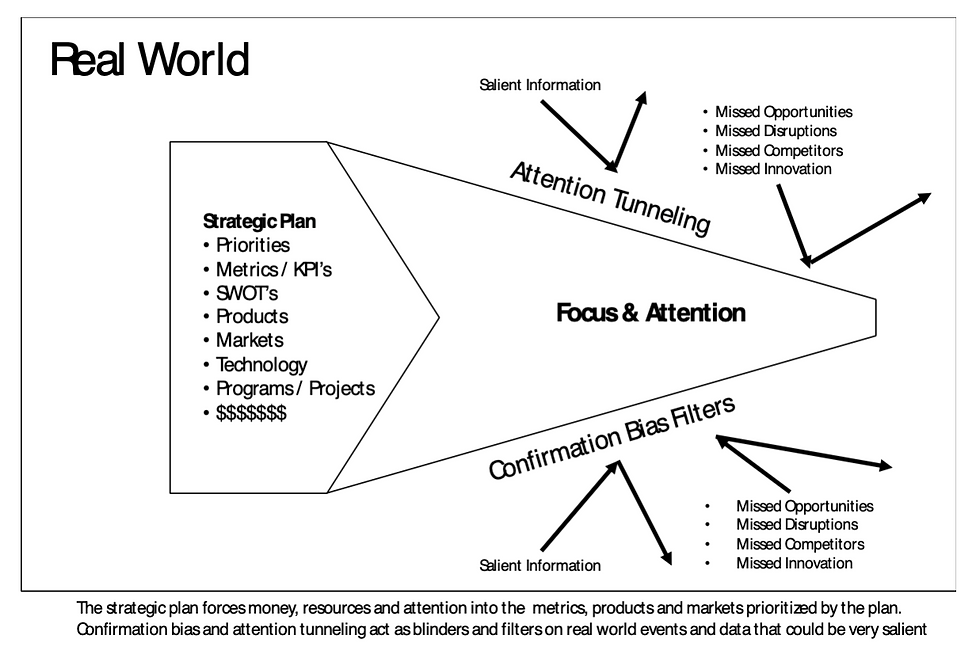
In a previous post (Strategic Planning or Strategic Blindness) I wrote about the dual effects of the Situation Awareness degradation factor, attentional tunneling, and confirmation bias. I described how these two forces, acting in concert, can put blinders on the organization around the point of view about the future expressed in the strategic plan. In this post I’ll describe several other situation awareness degradation factors and how they show up at the organization level.
A description of the factors and a description of what you can implement in your organization to counterbalance these factors, as well as other cognitive biases may be found in the book:
Top Gun Governance – Using Situation Awareness to manage and thrive in an increasingly complex and unpredictable world
These degradation factors were first identified by (Endsley, Bolte, and Jones 2003; Endsley 2021). As much, or most of the research, on situation awareness has been conducted at the individual level or team level, I have elaborated these factors to the organization level. How many of these factors do you recognize in your organization?
Situation Awareness Debilitation Factor | Enterprise-Level Characterization |
Attentional tunneling— locking in on certain aspects of the environment and either intentionally or inadvertently stopping visual scanning (SA will suffer when significant events fall outside what the person is focused on) |
|
Requisite memory trap— overload of short-term memory caused by too many features of the situation being present simultaneously |
|
Errant mental models— causing a decision maker to miss cues or explain away cues that don’t fit the chosen mental model |
|
Out-of-the-loop syndrome—gaps in understanding of how automation is performing or is supposed to be controlling the situation |
|
This last factor, Out of the Loop Syndrome, has special relevance for the new generation of Pre-trained Generative AI models. Not only is there not an actual algorithm that someone wrote and understands, but the models only perform as well as the data they’ve been trained on. If a class of events, data, people, medical outcomes, financial outcomes, or whatever, is under-represented, or not represented at all, the model may have very poor predictive capability in that area. Worse, it may “hallucinate” an answer with as much certainty as a result in which there has been ample training and therefore reliability. A case may therefore be made that these models may actually automate confirmation bias.
Is more and more of your business model and decision making buried in complex algorithms that fewer and fewer people truly understand, and exposing you to potential litigation? Perhaps it’s time for a check-up of your algorithms, statistical models, and now your methods for building robust AI generative models.
References
Endsley, Bolte, and Jones 2003; Designing for situation Awareness: An Approach to human Centered Design. CRC Press. Taylor and Francis Group
Endsley 2021, Situation Awareness Measurement: How to Measure Situation Awareness in individuals and Teams. Human Factors and Ergonomics Society
Stevens, Derek M., Top Gun Governance. Using situation awareness to manage and throve in an increasingly complex and unpredictable world. Newman Springs Publishing, 2023


Comments