Strategic Planning or Strategic Blindness

When your company rolls out a strategic plan, it is making a bet on the future; a particular future. Given that this strategy will inevitably come with investments in new & different technologies, a focus on particular customer demographics, a perspective on the economy or geo-political stability or instability, targets on which companies to buy or which lines of business to divest. The monetary resources to enact a strategic plan are easily calculated, but another key resource, namely attention and focus are less easily quantified. But, to be sure, there is a cost. Moreover, that cost goes under the radar because when you’re focusing on the variables and events in your strategic plan’s view of the future, you’re not focusing on other events and data that could mean that a different future is unfolding.s
The Double Whammy: Conformation Bias and Attention Tunneling
These two factors, one from Situation Awareness, the other a common cognitive bias are defined below.
Attentional tunneling— Locking in on certain aspects of the environment and either intentionally or inadvertently stopping visual scanning (Situation Awareness will suffer when significant events fall outside what the person is focused on).
Confirmation Bias— The tendency to seek out information that supports one’s position or world view, and either ignore or discount information that disconfirms one’s position. This is a coping mechanism to reduce cognitive dissonance. Cognitive dissonance is the discomfort that comes with trying to resolve conflict when information that doesn’t support one’s point of view is encountered.
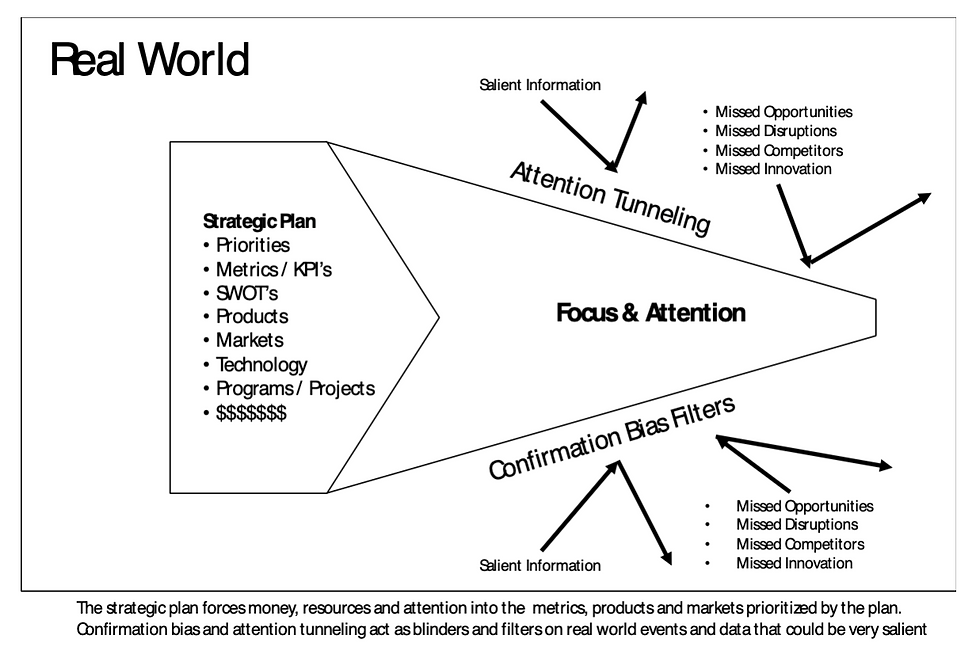
When a strategic plan is made and communicated, people will naturally focus on the information and priorities stipulated the plan. Because of confirmation bias, they will exclude, ignore or discount other real-world events and information that could disconfirm aspects of the plan; its point of view about the present and the future the plan is predicated on. Disconfirming information or information that is not deemed salient doesn’t make it through the filters.
There is also a finite amount of attention that mortals can devote to any given situation. The famous Miller’s number (7 plus or minus 2), is a well-researched limit of our short-term memory. We can keep anywhere from 5 to 9 pieces of information in our minds at one time. Any more, and something gets flushed from the buffer, and doesn’t make it into long term memory. Fundamentally, anything extraneous gets ignored, discounted, or forgotten completely.
Hence attention tunneling becomes a factor. It’s like the side blinders they put on racehorses to prevent them from becoming distracted by the other horses. Additionally, there is research to suggest that as the problems we deal with have become less physical, and much more abstract, requiring more and more higher neo-cortex brainpower, the situation is getting worse. We may be bumping up the biological limits of our brains to understand all the nuances of the complex situations we face.
These two very human tendencies will constrain focus and attention and act as important constraints on performance. A strategy, no matter how well thought out, if it is not in synch with events in the real world, becomes a drag on performance. Furthermore, the strategy will likely also be reinforced by investments made in systems and dashboards that measure what the plan deems important to measure. Those dashboards will not contain information that the strategy does not consider important. This is like constructing an airplane cockpit that excludes salient information like windspeed or altitude.
So, what’s a strategy to overcome attention tunneling, confirmation bias, and other cognitive biases, to:
Enhance our capacity to consider and effectively process information and events that may be salient, but not within the scope and filters of our strategic plans?
Ensure that our organization’s decision-making processes are not constrained, (frequently unconsciously) by attention tunneling and cognitive biases.
There is no silver bullet, but the answer lies in:
Building an organization that distributes situation awareness to everyone, so that better decisions are made…by everyone.
Recognizing how you may be impacted by other situation degradation factors like Requisite Memory Trap, Workload Anxiety & Fatigue, Data Overload, Misplaced Salience, Complexity Creep, Errant Mental Models, and one that is becoming especially important due to AI, Out of the Loop Syndrome.
Understanding how various cognitive biases can compound to keep your organization in a maladaptive strategy.
I’ll explore these in subsequent articles.
The whole approach is described in a book, Top Gun Governance - Using situation awareness to manage and thrive in an increasingly complex and unpredictable world. (Derek M. Stevens) Newman Springs Publishing (published November 2, 2023).


Comments